Professional women frequently fall into the trap of waiting for permission to lead. They wait for a specific job title, a formal promotion, or a direct endorsement from upper management before they feel authorised to step up. When you operate this way, you hand your confidence over to an external source. If you do not have the title, you stay quiet in meetings. If you do not have the mandate, you second-guess your strategic ideas. This hesitation is the root of imposter syndrome. You start to believe that until someone hands you a leadership badge, your voice does not carry weight.
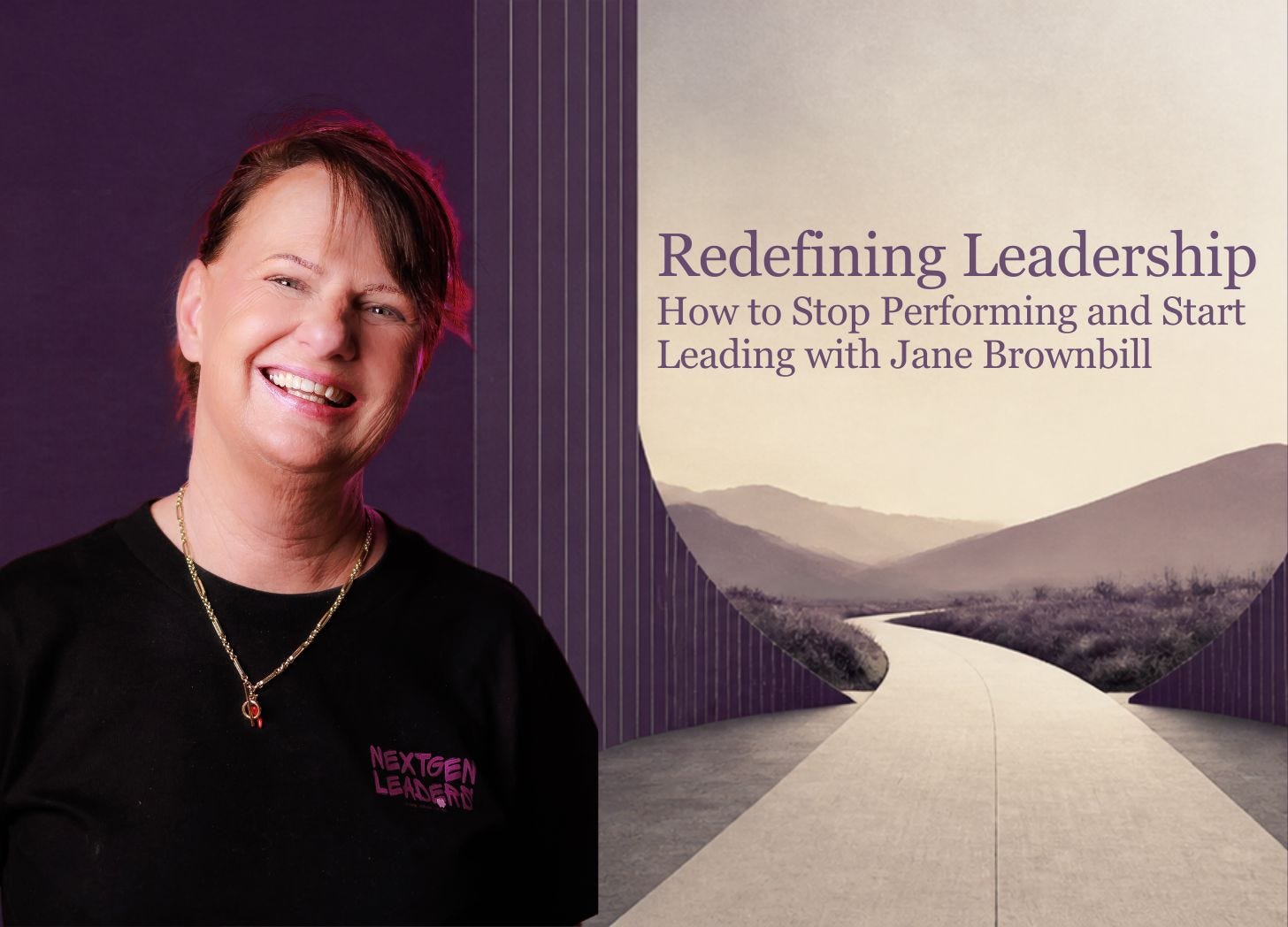
Jane Brownbill rejects this premise entirely. As a coach, the founder of See Yourself, and the President of Canberra Women in Business, Jane has built a career on the belief that leadership is a practice rather than a position on an organisational chart. She is also the driving force behind community initiatives like NextGen Leaders and the NeuroGenTech Hub. Her approach strips away corporate jargon and focuses on the unfiltered reality of what it means to lead authentically.
Confidence and good leadership come from within. They come from learning from your mistakes and accepting that perfection is unattainable. You do not need a specific toolkit to be a leader, and you certainly do not need to have all the answers before you begin. By examining Jane’s philosophy on team building, neurodiversity, and delegation, we can understand how to drop the performative aspects of management and step into genuine authority.
The Myth of the Title and the Rise of the Performative Manager
The corporate world is heavily populated by people who hold impressive titles but possess little actual leadership capability. These are the performative managers who curate a perfect image of a leader on the surface, yet they actively undermine the talented people working beneath them in the office.
This behaviour often operates from a place of deep insecurity. When a leader is threatened by the intelligence or capability of their team, they can actively keep people down to protect their own fragile identity. When a professional woman encounters a manager like this, it can severely damage her confidence and reinforce her internal doubts. It teaches her that success is about playing politics and protecting your territory rather than driving collective results.
To overcome this, you must completely redefine what leadership actually looks like in your daily practice. It requires you to remove the corporate structure from your definition of success and focus on the internal work required to trust your own instincts.
“Being a leader to me is about trusting yourself and your values. It has absolutely nothing to do with a title or an award, it is about standing up, being heard, and actually leading with your true self.”
You do not have to be a designated manager to have a goal or a vision. Leadership is simply the mechanism that gets you there. It is about being the person who is willing to stand up and say something when it matters. True leadership requires the exact opposite approach of the performative manager. You must intentionally hire and elevate people who are smarter and more capable than you. If your team members eventually outgrow their roles and take over your job, that is a mark of true success. You lift as you rise.
Radical Delegation and the End of Perfectionism
One of the most significant blocks for women trying to expand their leadership influence is the inability to let go of control. Perfectionism is a defensive mechanism. We tell ourselves that if we control every detail, rewrite every brief, and manage every outcome, we can protect ourselves from criticism. In reality, this behaviour severely limits your growth and exhausts your team. You cannot build a high performing environment if you are constantly acting as a bottleneck for quality control.
Jane operates with a completely different mindset. She is neither a perfectionist nor a control freak. She advocates for radical delegation. This means you have to trust your team first and make adjustments later. By defining your individual strengths, you will understand how your leadership can be an asset to any team without needing to micromanage every output.
“If you expect a completely different person to do it exactly the way you would have done it, you are dreaming.”
If you want a document written exactly the way you would write it, you need to write it yourself. But if you do that, you are failing as a leader because you are doing the work of your subordinates instead of focusing on strategic direction. You have to give people a piece of work, let them run with it, and tell them you are there if they need help.
Delegation is not about abdicating responsibility. When things go wrong, the buck stops with the leader. You do not throw your team under the bus for a mistake. You take responsibility publicly, you pull the team member aside for a constructive conversation privately, and you figure out what went wrong with the initial instructions. People have new ways of looking at things. If you force them to clone your exact methods, you miss out on their unique perspective and stifle their professional development.
Designing Environments for Neurodiversity
When you stop trying to force people into rigid corporate moulds, you make room for diverse problem solving. Jane’s work with the NeuroGenTech Hub perfectly illustrates this principle. The social enterprise was built to provide meaningful work for neurodivergent individuals, specifically NDIS participants who frequently face significant barriers to traditional employment.
Instead of forcing these individuals to adapt to a standard business environment that does not suit their needs, Jane built the environment around their natural inclinations. The premise of the business is straightforward. They take old technology, fix it up, and sell it. In a small enterprise like this, you need people to handle marketing, inventory, administration, and technical.
From the very beginning, Jane let the group choose their roles based on what they were naturally good at. One person became the creative lead, another the document master, and another the designated problem solver. Her only title was directing traffic. She handed the responsibility over to them completely.
“I have said it so many times, this is not my own. This is yours. And the change in them, the confidence, the excitement is amazing.”
When you put people in an environment where they are respected for exactly who they are, their entire demeanour changes. They stop apologising for being different. Jane noted that one of the members recently stepped up to mediate a conflict between two other people in a separate workplace. Six months prior, he never would have had the confidence to do that. That is what happens when you give people a safe space to belong. They stop trying to mask who they are and start contributing their actual skills to the community.
Finding Your Tribe
You cannot build your presence and leadership in isolation. You need a community that understands your goals and supports your growth. Jane advises that finding your tribe requires you to put yourself in uncomfortable situations. You have to attend the events, show up in the rooms, and network.
For many professionals dealing with imposter syndrome, walking into a room full of strangers is a highly stressful experience. The fear of being exposed kicks in, and the instinct is to hide in the corner, look busy on a phone, or avoid the event entirely. To overcome this, you need one practical strategy to navigate these events effectively.
If you want to expand your influence but hate networking, you must change your physical approach to the room. Do not aimlessly wander the floor or try to awkwardly interrupt established groups. Instead, use a targeted positioning tactic based on human behaviour.
When you arrive at a networking event, locate the bar or the primary refreshment station. Find the exact point where the line ends and people step away with their drink. Position yourself just outside of that exit path.
This strategy works because it capitalises on natural social transitions. When a person first walks into a networking event, their immediate goal is to secure a drink. This gives their hands something to do and provides a temporary buffer against the awkwardness of the room. While they are in the line, their focus is entirely on that task. They are closed off to new interactions.
The moment they receive their drink and turn away from the bar, that task is complete. They look up, scan the room, and suddenly realise they have nothing to do and no one to talk to. They are actively seeking a conversation to avoid standing alone. If you are positioned right at that exit point, you become the most convenient person in the room. You do not need a complex elevator pitch. You simply make eye contact, smile, and introduce yourself.
This single positioning shift will result in higher quality conversations and a much stronger professional presence. It completely bypasses the awkwardness of cold approaches. Commit to trying this tactic at your next networking event.
What are you waiting for?
“True leadership is not a title you are handed. It is the conscious decision to stop performing, empower the people around you, and step into any room knowing your unique value is exactly what is needed.”
Stop waiting for permission to lead, define your individual strengths, and start taking deliberate action to build the career you want.
Connect with Jane Brownbill
Connect with Jane: LinkedIn
See Yourself website: seeyourself.net
Canberra Women in Business: cwb.org.au