The modern workplace operates at a relentless pace. As leaders, we are expected to guide our teams through economic shifts, technological upheavals, and shifting political landscapes. Yet, the corporate systems we work within are often built for a world that no longer exists. They demand predictable, linear progress. When the environment inevitably shifts and carefully laid strategic plans fall apart, it is easy to internalise that disruption as a personal failure.
This disconnect between expectation and reality is a primary trigger for imposter syndrome. You might feel you need to have all the answers to justify your position. The reality is that expecting perfection in an unpredictable world is a trap. True leadership confidence does not come from predicting the future perfectly. It comes from accepting that multiple futures are possible and building the resilience to navigate whichever one arrives.
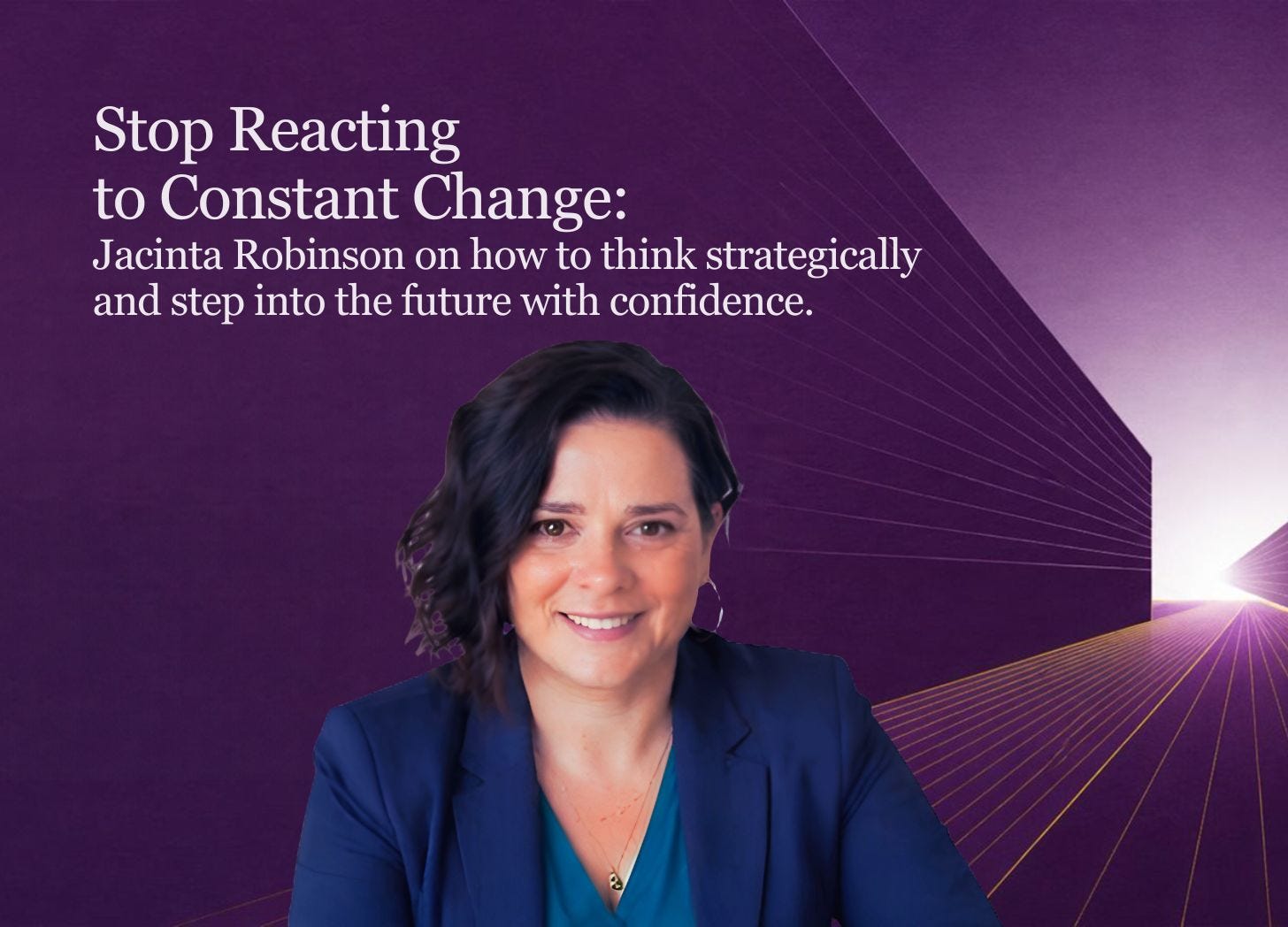
To understand how professional women can break through these confidence blocks and expand their influence, I sat down with futures coach and strategic advisor Jacinta Robinson. Following a fifteen year career in national security, Jacinta now helps individuals and organisations anticipate change rather than just react to it. Our conversation explored the harsh realities of the modern workplace, the vulnerability of returning from maternity leave, and the critical skill of futures literacy.
The Illusion of the Linear Strategy
For decades, corporate and government structures have relied on stability. We draft five year strategic plans and set rigid career milestones. We operate under the illusion that our progression will follow a straight upward trajectory if we simply work hard enough. Jacinta is quick to point out that this is a fundamentally flawed premise. We live in an era of volatility, but our management structures have not caught up. Jacinta notes that this lag is actively harming workplace culture.
“The world is going through this massive transformation that is creating lots of uncertainty, lots of volatility, and lots of unpredictability,” Jacinta explains. “And the people that are in those leadership positions right now are leading like the world hasn’t changed because they’re still using the same systems and processes.”
When you adhere strictly to a linear mindset, any deviation feels like a catastrophic error. This rigid thinking is what creates psychologically unsafe work environments. If a team feels they must stick to the original plan regardless of changing circumstances, they will hide early warning signs of failure. As a leader, if you punish deviation, you are cutting yourself off from vital information. To bring genuine value to your organisation, you must shatter the illusion of predictability. Growth happens in the messy middle where plans break and you are forced to adapt. When you stop fighting the reality of change, you can start identifying the early signals that a shift is coming.
The Systems Thinker Advantage
Building your presence and authority as a leader requires you to look beyond your immediate silo. You must understand how broader economic, technological, or social factors will impact your team. Jacinta refers to this capability as futures literacy. It is the ability to connect the dots early and anticipate disruption before it hits your desk.
“When people talk about that they’re doing strategic thinking as leaders, often they’re not,” she says. “And when I talk about seeing that change, thinking like a systems thinker, that to me is the level of strategic thinking that is required for this world that’s kind of going through this massive transformation.”
Many leaders fall into the trap of confusing operational management with strategic foresight. Reviewing a quarterly budget is operational. Recognising that a geopolitical conflict will eventually drive up your local supply chain costs is strategic. Anticipating these shifts gives you a distinct advantage. It allows you to build a buffer, pivot your strategy, and maintain your presence and authority when others in the organisation are panicking.
Jacinta advises that the best way to build this literacy is to change your information diet. Relying on mainstream evening news means you are consuming information too late. To spot the early signals of change, you need to read independent journalists, industry think tanks, and academic reports. You are looking for the faint signals in the noise. By the time a disruption is making global headlines, the window for proactive strategy has already closed.
Thought Leadership in the Grey Space
When leaders develop futures literacy, their perspective naturally shifts. They begin to see the flaws in traditional corporate narratives. This is where true thought leadership is born. Thought leadership is not about repeating popular industry trends. It is about identifying the gaps and asking the questions nobody else is willing to ask.
In an environment saturated with artificial intelligence and regurgitated content, bringing unique value means leaning into nuance. We are frequently presented with binary choices in the corporate world. Things are either a success or a failure. A strategy is either right or wrong. Jacinta argues that leaders must become comfortable navigating the grey space.
When you speak up about the uncertainties facing your industry, you decouple your identity from the safety of the status quo. You demonstrate that you are not relying on a formal job title to give you authority. You are building your confidence on your internal capability to analyse, question, and adapt. This level of honesty requires courage, but it establishes you as a deeply credible leader.
The Strategic Shift
Constant change and strategic failures will trigger your imposter syndrome. You cannot control external volatility. You cannot control global markets, sudden technological shifts, or executive board reshuffles. You can only control your response.
When a major plan derails, the most common reaction is a feeling of powerlessness. Leaders freeze, or they frantically try to force a broken strategy to work. To stop reacting blindly and start shaping your trajectory, you must implement a specific tactical exercise. You need to conduct a Strategic Shift.
This exercise is directly inspired by the final stage of Jacinta’s method. “It gives you the power to make confident decisions and own it and own the future and not feel like it’s just happening to you,” she explains.
Here is how you execute the Strategic Shift in your leadership practice today.
First, acknowledge the disruption objectively. When a project derails or an external factor forces your strategy off course, write down exactly what has happened. Remove the emotion. Do not write that your project has failed. Write that a specific external factor has made the current timeline unviable.
Second, draw a hard line between what you control and what you do not. List every factor of the disruption. If supply chain costs have doubled due to global logistics issues, put the global logistics issues in the ‘Out of My Control’ column. You cannot change them, so you must stop wasting mental energy worrying about them.
Third, identify your levers. Look at the ‘In My Control’ column. What levers can you actually pull. If you cannot change the cost of a material, can you change the packaging. Can you alter the delivery method. Can you renegotiate a secondary contract to offset the cost. You are looking for the specific, actionable elements of the project that still belong to you.
Fourth, design your pivot. Choose the strongest lever from your list and draft a new, modified approach. You are not trying to save the original plan. You are designing a new path based on the current reality.
Finally, communicate the pivot with authority. Take your revised plan to your team or stakeholders. Do not apologise for the external disruption. State clearly what has changed, outline the elements that are out of your control, and present the specific actions you are taking to reclaim agency over the outcome.
Confidence and good leadership come from within. They are built through learning from your mistakes and accepting that perfection is unattainable. When you conduct a Strategic Shift, you stop being a victim of circumstance. You stop viewing unexpected disruptions as definitive failures. Instead, you use professional difficulties to prove your strategic agility. By learning to anticipate change and focusing only on what you can control, you decouple your identity from external chaos. Embrace the messy reality of modern leadership, own your unique value, and lead with absolute authority.
Connect with Jacinta Robinson
Future Pivots Website: FuturePivots.au