I recently found myself unpacking a deeply uncomfortable leadership truth. When a team member repeatedly withholds critical project updates, speaks over you in meetings, or quietly rallies colleagues against a new initiative, the immediate reaction for most leaders is to look inward. You replay conversations on the drive home. You wonder if you need to be firmer, kinder, or simply better prepared. You internalise the tension as a personal inadequacy.
As a leadership coach, I spend my days helping professionals dissect imposter syndrome and self-doubt. I see firsthand how professional women are conditioned to believe that any friction in their team is a direct reflection of their own communication skills. But as I discovered during my recent interview with workplace culture and leadership expert Maureen Kyne, this reaction completely misses the core issue. You are not experiencing a personal failure of leadership. You are likely facing upward bullying.
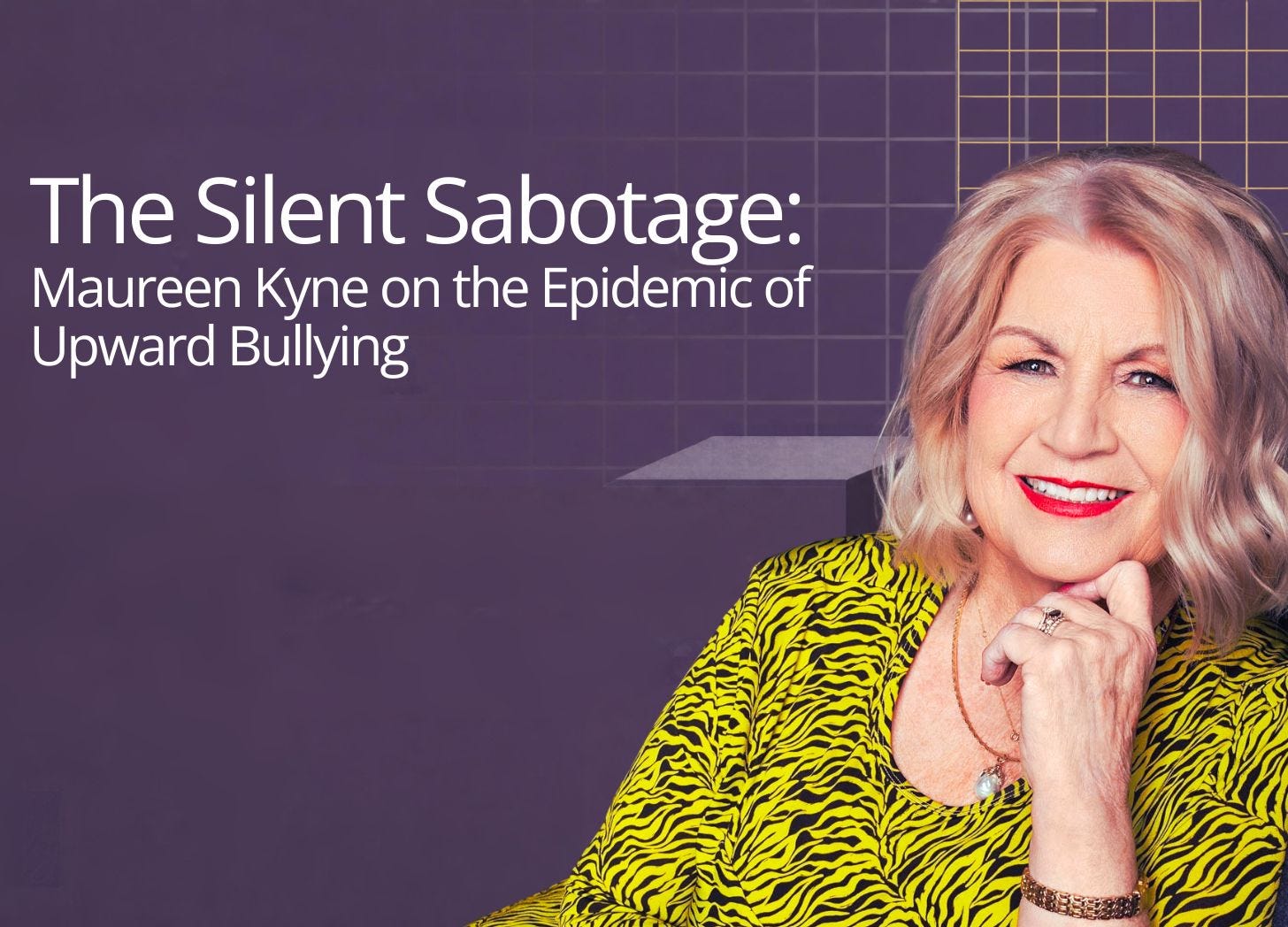
I invited Maureen onto The Leadership Confidence Podcast to unpack this hidden workplace epidemic. What followed was a conversation that completely reframed how I view team resistance, accountability, and the illusion of the perfect manager.
The Hidden Crisis in Executive Leadership
Downward bullying from senior managers receives significant attention in workplace policies, human resources training, and corporate literature. Upward bullying operates differently. It is far harder to spot because it subverts the traditional power dynamic we are taught to expect. It rarely involves obvious confrontation. Instead, direct reports use subtle mechanisms of harm to chip away at a leader’s authority over time.
Maureen’s global research reveals a staggering reality that stops most leaders in their tracks. 71% of senior leaders report personal experience with upward bullying. Even more alarming, 93% of leaders effected state that it severely damaged their confidence, reducing their willingness to remain in executive roles.
I asked Maureen to break down how this actually manifests in day-to-day operations and why it catches so many experienced executives off guard.
“It is a form of harm that is perpetrated either by an individual, but more often than not by a group of individuals who report to the leader,” Maureen told me. “It is an intentional form of harm because that leader may be in the role and might be new to the role, or brought in to do transformational change. Generally, you will find that there is one person within the team who has informal power around what is actually happening. Their agenda is to disrupt the leader and potentially get rid of them.”
Defining the Tactics of Upward Bullying
The data Maureen shared highlights exactly how pervasive these tactics are in the modern workplace. Her research indicates that 75% of targeted leaders experience resistance or refusal to follow direction. Another 64% experience targeted gossip or damaging rumours, while 61% face sabotage or deliberate withholding of vital information.
Perhaps most alarming is that 60% experience “mobbing,” where team members form a group to collectively target or undermine the leader. Furthermore, 57% face strategic formal complaints or grievances designed purely to stall accountability and tie the leader up in administrative red tape.
A common misconception I held before our interview was that this behaviour must target specific demographics or inexperienced managers. Maureen quickly corrected this assumption. Her research shows that upward bullying spans right across the board. It occurs in healthcare, higher education, legal firms, manufacturing, and executive suites alike. No specific cohort or industry is immune to this dynamic.
The Trap of Internalised Blame
Listening to Maureen, I reflected on how this impacts our core philosophy of leadership confidence. When you step into a leadership role with a commitment to empathy, kindness, and collaboration, high-conflict individuals may misinterpret your supportive approach as a weakness.
When you attempt to address poor performance or introduce organisational change, a high-conflict employee may switch from passive resistance to active sabotage. Because we are often taught to prioritise relationship-building and self-reflection, this upward pushback creates an intense internal conflict. You begin to question your delivery. You ask yourself if you were too abrasive, or conversely, if you lacked sufficient authority.
I asked Maureen why leaders so easily slip into self-doubt rather than seeing this behavioural pattern for what it is. Her answer highlighted a critical flaw in how we manage team dynamics.
“Generally a leader looks at these things in isolation,” Maureen explained. “They are not looking at them collectively together. We have held some information here, or we have come into a group meeting where they have been disruptive. So a leader looks at these things in isolation. We are allowing these tasks that they should have been doing to slip under the radar because they just seem minor or minuscule. But the more we do not address it, the more we empower that individual and the group to up the ante.”
This self-doubt is precisely what enables the behaviour to escalate. When a leader views systemic disruption as a personal failure, two counterproductive reactions typically follow. First, they retreat into conflict avoidance. They hesitate to enforce standards, delay performance reviews, or overlook missed deadlines to prevent further team backlash. Second, they attempt aggressive overcompensation. They try to force compliance through rigid dominance, which only escalates tension and fuels the employee’s narrative that the manager is unreasonable.
Both reactions stem from the exact same root cause. The leader is conflating their personal identity with their official function. They forget that leadership confidence comes from within and that learning to handle friction is part of the process.
The Linguistic Boundary: “In My Role”
During our interview, Maureen introduced a psychological and verbal repositioning strategy. It uses a precise, short verbal anchor to establish professional authority during difficult performance or behavioural discussions.
The anchor is simply this phrase. “In my role as your leader...”
On the surface, this looks like a basic conversational opener. In practice, it is a sophisticated tool for cognitive and emotional regulation in high-stress environments. Using this phrase anchors the conversation to your objective duties and organisational responsibility. It shifts the discussion entirely away from personal friction.
I want to dive deep into exactly why this phrase works. When these words are spoken in a meeting room, a profound mindset shift occurs for both the leader delivering the message and the employee receiving it.
The Mindset Shift for the Leader: Shedding the Personal Burden
When you anticipate a difficult conversation with a direct report who has been undermining you, the physical signs of anxiety are immediate. Your heart races. You feel a knot in your stomach. This happens because you are entering the room as yourself. You are walking in as a person who wants to be liked, who wants to be perceived as fair, and who fears being labelled as a bad manager. You carry the burden of your personal identity into the conflict. You feel the need to justify your decisions, soften your tone, and seek approval for the boundaries you are trying to set.
Saying the words “In my role as your leader” acts as a cognitive trigger. It works similarly to the psychological concept of enclothed cognition that I teach my clients. Just as putting on a tailored blazer can instantly make you feel more authoritative and capable, speaking this phrase wraps you in the protective armour of your professional function. You are no longer negotiating your personal worth. You are executing the requirements of your position.
Maureen explained this perfectly during our chat. “We are giving ourselves that opportunity to be able to step back as a leader into the role that we need to be undertaking. I think you are empowering the leader not to be either aggressive or avoiding.”
This mindset shift grants you permission to be objective. It relieves you of the impossible task of being the “perfect” communicator. You do not need the employee to validate you personally. You only need them to meet the operational standards dictated by the organisation. By verbally naming your role, you detach your ego from the outcome of the conversation. If the employee pushes back, they are not rejecting you, they are rejecting the role and the business requirements. That simple separation is the key to maintaining your composure and confidence.
The Mindset Shift for the Employee: Neutralising the Weapon
Upward bullying thrives on interpersonal friction. A high-conflict employee gains power by turning operational matters into personal disputes. If they miss a deadline and you address it, they will try to shift the focus to your tone, your management style, or a perceived personal slight. They want to argue with you, the individual, because personal dynamics are subjective and easily manipulated. When you open a difficult conversation with “In my role as your leader,” you immediately strip them of this weapon.
You change the rules of engagement before they can even mount a defence. Hearing this phrase forces a sudden cognitive shift for the employee. The boundary is drawn clearly. They are no longer dealing with a frustrated colleague they can manipulate emotionally. They are suddenly face-to-face with the structural authority of the organisation.
Consider the difference between saying, “I need you to stop speaking over me in meetings,” versus, “In my role as your leader, I need us to establish clear communication standards for team meetings.”
The first statement invites a personal argument about whether they actually spoke over you, how sensitive you are, or what their intent was. The second statement leaves no room for personal negotiation. It states an organisational requirement. The employee is forced to realise that their passive-aggressive tactics will no longer work. They cannot claim that you are just being vindictive. To continue their resistance, they must actively refuse the explicit, professional requirements of their job. This shift forces accountability. It backs the employee into a corner where they must either align with the professional standard or provide documented evidence of their refusal to cooperate with management.
Finding Confidence Through Imperfect Leadership
My conversation with Maureen Kyne was a powerful reminder that we must stop trying to perfect the unperfectible. Leadership is not about achieving a state of flawless performance where everyone agrees with your direction. Perfection is an illusion. True confidence and good leadership come from within, learning from our mistakes, and accepting that friction is a natural part of managing people.
Upward bullying thrives when leaders feel isolated, doubt their capabilities, and treat opposition as proof of personal inadequacy. When you step back, observe the behavioural pattern objectively, and anchor yourself firmly in your professional function, you remove the emotional leverage used to undermine you. You do not need to alter your core personality, adopt an overly aggressive management style, or pretend to have every answer to command respect. You simply need to stand securely in your authority, enforce objective standards, and lead with clarity.
Resources & Links
Maureen Kyne
Website: Access Maureen’s research report, white paper, and book information at maureenkyne.com.au
Connect with Maureen: LinkedIn