Key takeaway: Failure is an opportunity for growth and improvement. Find the lesson in mistakes and you will become more confident next time.
This is a time I failed.
I was working for a new boss and trying to get them onboard with a cultural reform project I had developed. I had already changed the name for the project from what the higher ups wanted. I knew language was important and wanted the staff on board from the get go. I changed the stressful word ‘change’ to ‘improvement’ and the aggressive word ‘taskforce’ to the gentler ‘program’ to help staff see the positives in what we were trying to achieve. In order to advise the teams of this ‘Improvement Plan’ I said we were holding a virtual Town Hall for the 500 plus staff. I had aced it with the boss, she loved it and approved my plan for the meeting. I smugly thought to myself, “I have won over the boss with the amazing term town hall. Well done me.”
Cut to the meeting a week later and no one turned up for the announcement. FAIL! When I ran into some of the staff a little while later I asked them why they didn’t attend. Their response made me realise that I was trying to impress the wrong people. For all of my focus on making sure I got the terms of the Improvement Program right and my boss onside with the plan. The staff had never heard of a town hall and assumed it wasn’t for them. I was focused in the wrong direction and got it wrong.
The inevitability of failure
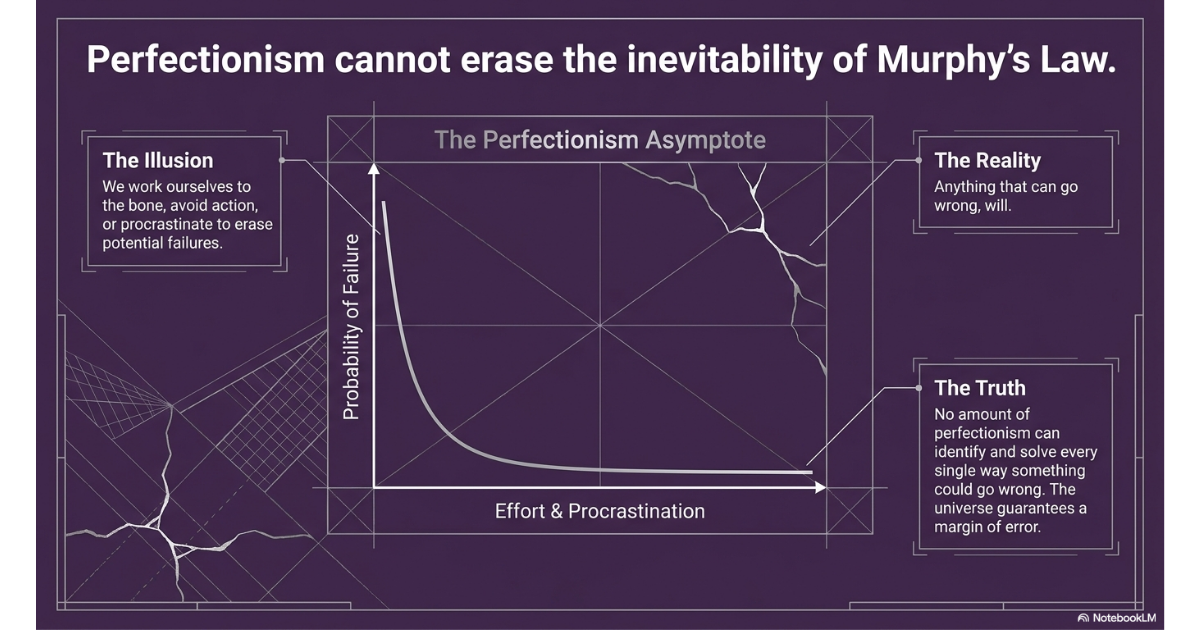
Failure, making mistakes or getting it wrong are all parts of being human. Nothing will ever go perfectly so how do we prepare for this eventuality. Many of us have a perfectionist mindset and often procrastinate, avoid action or work ourselves to the bone to try and erase any potential failures. And something still goes wrong.
Murphy’s Law states “anything that can go wrong, will.”
While not a definite, it encourages us to plan for all of the obvious ways something will fail. What that usually means though is that something we didn’t foresee will go wrong instead. It is the nature of the universe and no amount of perfectionism, procrastination and excessive work hours will identify and solve every single way something could go wrong.
Embracing failure
Our relationship with failure is a key indicator of how we manage stress in the workplace.
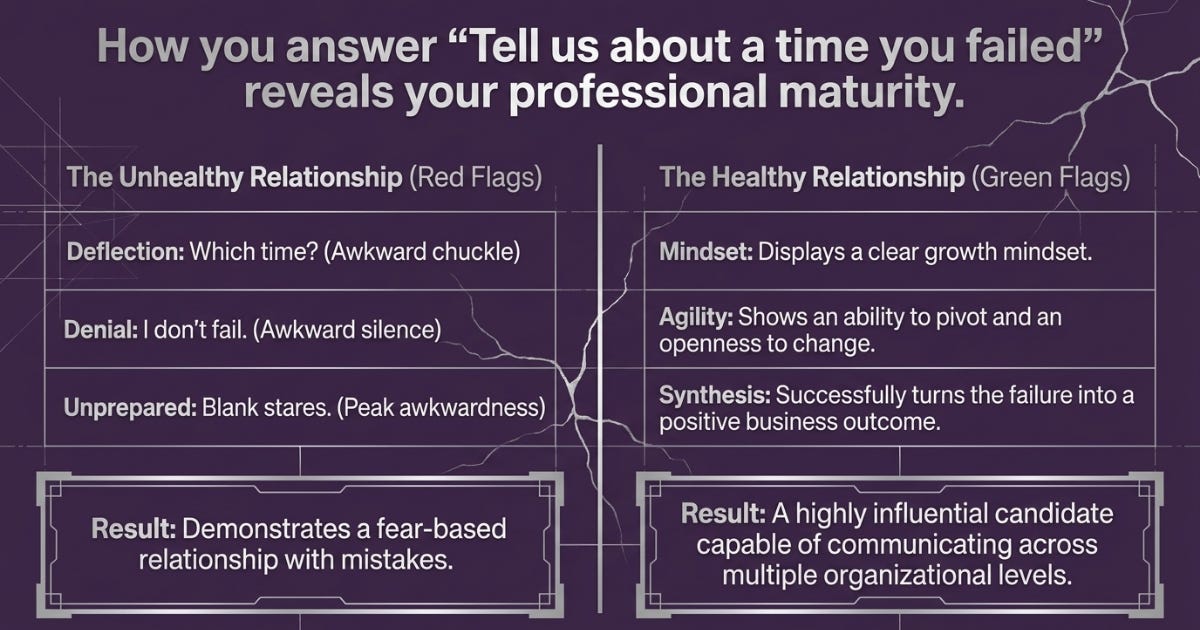
Interviewer: “Tell us about a time you failed?”
How not to answer:
Which time? (awkward chuckle)
I don’t fail. (awkward silence)
Blank stare because you weren’t prepared for this question. (peak awkwardness)
I have seen all of the above responses play out in an interview and lets just say anyone who answers in those 3 ways doesn’t get the job.
Last week I had a conversation with a client about being prepared for this question in an interview. She said she hated the question because in her experience people only see failure as something to be feared and it seemed like a gotcha question.
I love asking this in interviews and here’s why. The answer demonstrates how mature you are professionally. Answering in any of the above ways demonstrates a potentially unhealthy relationship with failure. Where as a prospective employee who structures an answer that shows a growth mindset, ability to pivot and openness to change is a strong candidate in any room. Bonus points if you are able to turn the failure into a positive outcome.
I have used the ‘Improvement Plan’ failure in interviews before, even when not directly asked about failure. I see it as a keep growth point in my ability to communicate across multiple levels in an organisation. I learnt the importance of tailoring your messaging to the right audience members to get the best results. As a leader the higher you go the much broader range of influence you have in an organisation. It’s important to get the message out in a way that everyone will understand it.
How failure impacts psychosocial safety.
Psychosocial safety in the workplace is becoming more of a focus as we look to understand the impact stress and burnout can have on overall productivity and culture. One of the key components in a safe workspace is how the organisation responds to failure. As leaders, we need to accept that failure is inevitable and ensure our reactions to it are not creating an unsafe environment for ourselves and those around us.
As leaders how do we create a safe workplace psychosocially.
Staff need to feel they can speak up without backlash identifying risks or failures.
When staff speak up early to identify hazards, risk mitigation can be put in place. The more you respond in a negative way to failure, the less likely staff are to feel comfortable pointing out risks or owning up to mistakes.
Leaders need to view failure from a place of curiosity instead of fear.
When leaders lash out with frustration, anger, and in extreme cases threats and abuse when things go wrong you are leading with fear. Even if this brings about change to mitigate the failure in future, you have built a culture around fear, isolating team members and inducing a negative workplace which people don’t want to be part of.
Approaching failure from a place of curiosity instead, encourages improvement, identifies gaps and allows people to feel heard. Next time there is a failure in the team, instead of getting worried or annoyed, instead ask some questions of yourself or the team.
Why did the failure occur?
Do we have a procedure?
Was the procedure followed?
Why wasn’t the procedure followed?
Is the procedure fit for purpose or unreasonable?
A healthy relationship with failure
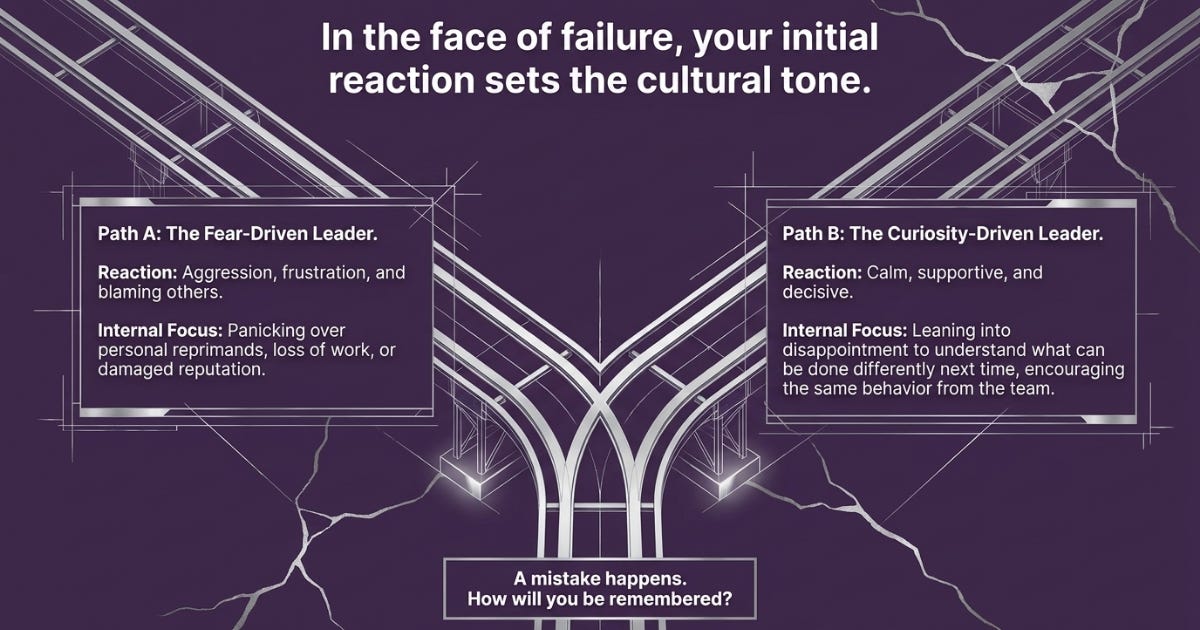
As a leader, others look to you in the face of failure and your initial reaction will set the tone for the initial resolution and ongoing culture of the work environment. While it is important for you to accept that not everything will go to plan, how you react to the failure will be how people remember you. People who respond with aggression, frustration, blaming others or other emotional reactions aer focused on the impact the failure has on them. They are worried it could result in a reprimand, loss of work, damaged reputation and more. Leaders who remain calm, supportive and decisive will encourage that behaviour from those around them.
Remember: Failure will happen but the sooner a mistake or failure is identified the easier it is to resolve.
Don’t get me wrong, you are allowed to be disappointed. Disappointment is almost as inevitable as failure. It is how you use that disappointment to improve for next time. It is how you lean in to that failure to understand what you could do differently.
Practice makes perfect better.
Take action: Next time you ‘fail’ take it as an opportunity for growth and learning rather than a set back.