Prefer to listen to listen to or watch? Head to Episode 7 of the Leadership Confidence Podcast.
When you step into a significant leadership role, your internal monologue changes. You might find yourself leading a larger team, steering strategic priorities, or managing high-stakes projects, only to be met by a persistent voice questioning your authority.
Many professional women attempt to manage this friction by acquiring more technical qualifications, over-preparing for routine meetings, or working excessive hours to prove their worth. Real leadership confidence does not come from endless credentials or flawless execution. It comes from within. It develops when you learn from your mistakes, accept that perfection is completely unattainable, and build practical tools to navigate internal self-doubt.
To overcome the internal barriers that stall career progression, you must first understand the fundamental difference between generic imposter syndrome and deep-seated negative self-talk.
Imposter Syndrome Versus Negative Self-Talk
While both experiences create internal resistance, they operate at vastly different levels of your subconscious mind.
Imposter Syndrome is situational and generic. It sits on the surface of your professional experience and activates whenever you step outside your familiar comfort zone. When you take on a new portfolio, present to an executive board, or step into a higher salary band, your brain interprets the unfamiliarity as a potential threat. It signals discomfort, urging you to retreat to safety. Imposter syndrome can usually be managed using short-term cognitive tools, such as reflecting, reframing, and taking immediate action.
Negative Self-Talk is personal, specific, and historical. It does not simply react to a new project. It actively narrates your overall competence using an outdated script written decades ago. It stems from conversations, feedback, and experiences accumulated throughout your childhood, school years, and early career.
Where imposter syndrome says, “I feel uncomfortable because this task is new,” negative self-talk says, “I am fundamentally incapable of doing this task.”
Because negative self-talk is deeply ingrained, attempting to suppress it through force creates an exhausting internal struggle. You cannot simply ignore these thoughts away. Instead, you need a visual framework to map where these thoughts live and a systematic process to strip them of their power.
The Mental Cave System
To understand how negative self-talk operates, picture your mind as a vast cave system opening out over a sunlit valley. This mental cave system consists of three distinct zones, each requiring a different strategy.
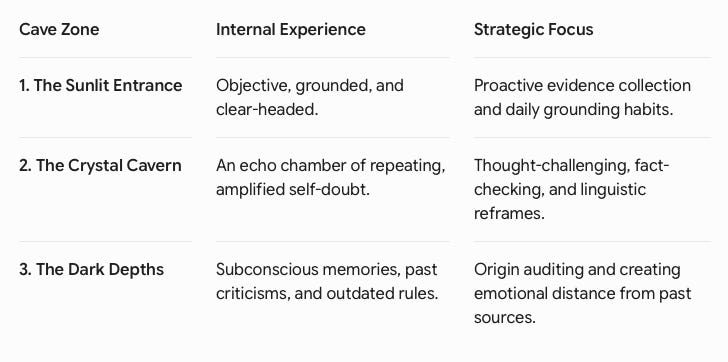
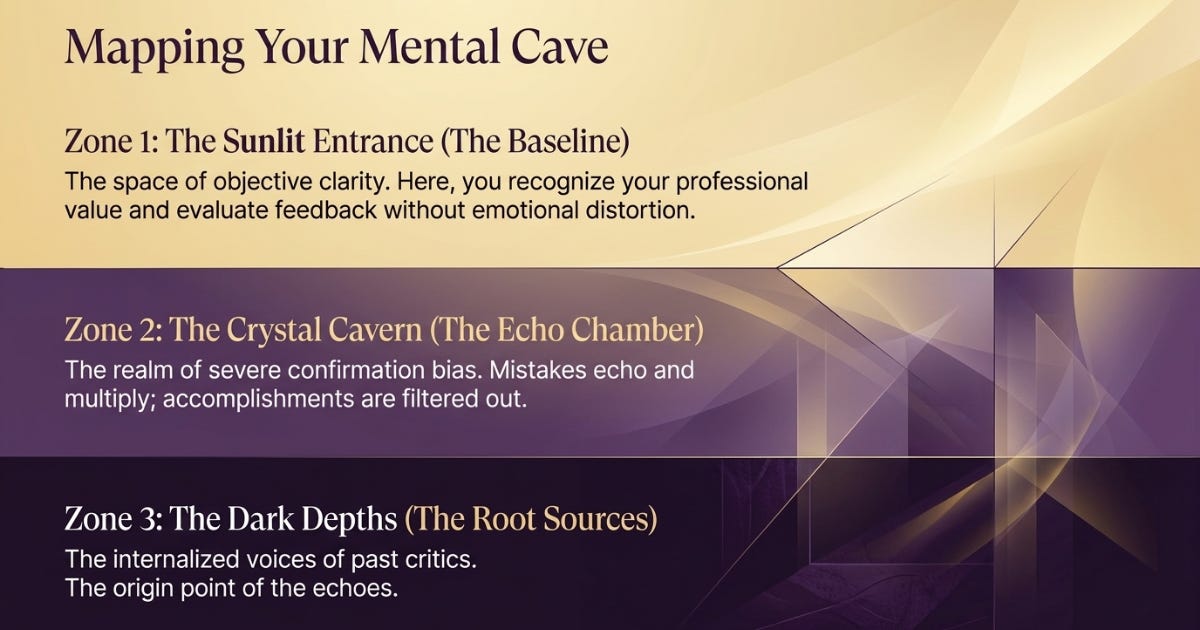
Zone 1: The Sunlit Entrance (The Baseline)
At the mouth of the cave, the light is bright, the air is clear, and you can look out over your career with objective clarity. In this space, you recognise your professional value, evaluate feedback logically, and make decisions without emotional distortion.
You will not stay at the sunlit entrance every hour of every day. High-pressure environments inevitably push you deeper into the cave. Therefore, the work you do while standing in the light is designed to set you up for success when you find yourself in the dark.
Zone 2: The Crystal Cavern (The Echo Chamber)
Further inside the cave lies a cavern of reflective rock. When a negative thought enters this space, it bounces off the walls, multiplying and echoing until it fills your entire mind.
The echo chamber operates on severe confirmation bias. It obsessively logs every moment you made a mistake, stumbled over your words, or made a minor error, while completely filtering out your accomplishments. In this zone, single stumbles are magnified into absolute statements about your worth as a leader.
Zone 3: The Dark Depths (The Root Sources)
In the deepest parts of your subconscious lie the original sources of your inner critic. These are the internalised voices of hyper-critical past managers, competitive colleagues, demanding teachers, or early family dynamics. The negative thoughts bouncing around the crystal cavern are almost always echoes originating from these dark depths.
Zone 1 Tactics: Building Your Evidence Ledger in the Light
When you are trapped in an echo chamber of negative self-talk, you cannot rely on memory alone to recall your strengths. Your brain is actively blocking positive data. You must prepare your evidence while you are standing in the sunlit entrance.
Proactive grounding is not about forced positivity. It is about documenting objective facts.
Maintain a Positive Feedback Diary: Keep a digital folder or physical notebook dedicated exclusively to written praise, successful project outcomes, and positive performance reviews. When your inner critic claims you are incompetent, this diary provides tangible proof to the contrary.
Integrate Low-Friction Reflection: You do not need an elaborate two-hour morning routine to build self-awareness. Utilise existing transition spaces, such as your evening commute home, to mentally review three things that went well during the day.
Normalise Professional Support: Unpacking complex personal patterns is heavy work. While leadership coaching helps you build strategic frameworks and move forward, deeper psychological trauma requires a qualified therapist. Engaging professional support, whether through an Employee Assistance Program (EAP) or a private practitioner, is a sensible leadership investment, not a sign of weakness.
Zone 2 Tactics: The Thought-Challenging Protocol
When you enter the crystal cavern and negative thoughts start spiralling, attempting to silence them completely will backfire. Forcibly suppressing self-doubt consumes massive amounts of cognitive energy. The goal is to demote the voice, challenge its accuracy, and reframe its message.
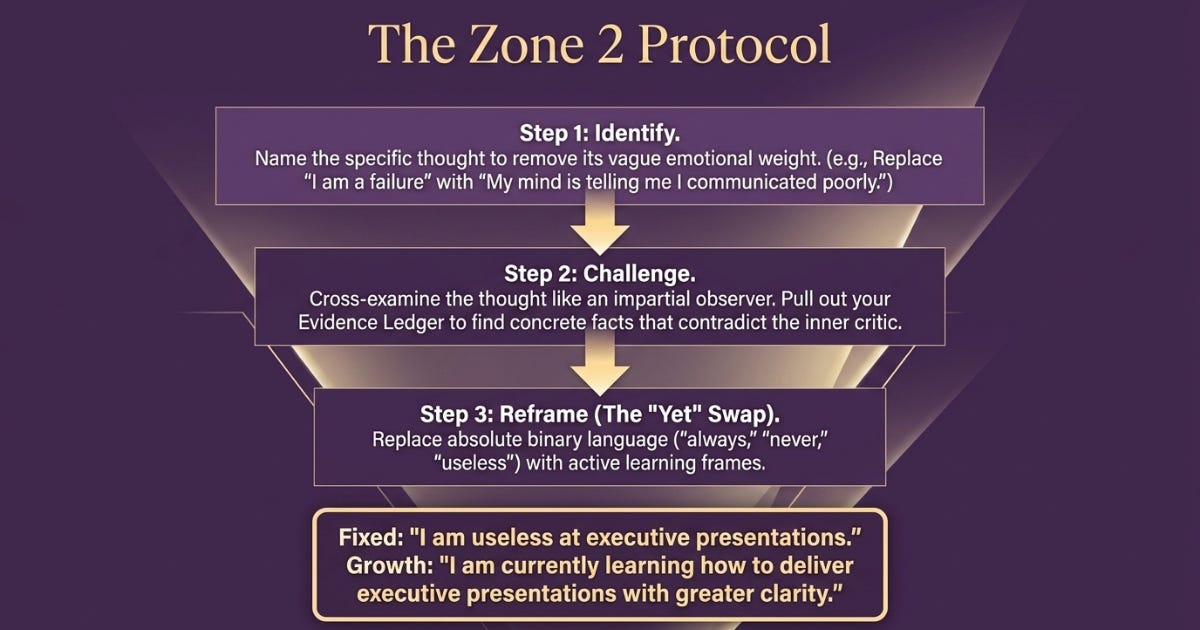
When a statement like “I am terrible at giving my team direction” begins to echo, execute this three-step protocol immediately.
Step 1: Identify the Specific Thought
Identify the exact phrase your inner critic is repeating. Write it down or state it explicitly to remove its vague emotional weight. Replace “I feel like a failure” with “My mind is telling me that I communicated poorly in that team meeting.”
Step 2: Challenge the thought
Cross-examine the thought like an impartial observer. Ask yourself: What concrete facts support this statement? What concrete facts directly contradict it? Pull out your Positive Feedback Diary to review real evidence.
Step 3: Reframe the thought
Absolute binary language like “always,” “never,” or “useless” creates self-fulfilling prophecies. Rewrite the thought by inserting the word “yet” or framing it as an active learning process.
The Power of the “Yet” Swap
Notice the shift in internal chemistry when you alter your language:
Fixed Statement: “I cannot manage complex departmental budgets.”
Growth Reframe: “I have not mastered complex departmental budgeting yet, but I am developing the skill.”
Fixed Statement: “I am useless at executive presentations.”
Growth Reframe: “I am currently learning how to deliver executive presentations with greater clarity.”
Reframing does not mean pretending you are flawless. It means granting yourself permission to be a work in progress. Practice makes progress, perfection does not exist.
Zone 3 Tactics: Voices in the Dark Depths
The most transformative step in dismantling negative self-talk is tracing a recurring thought back to its origin. Negative self-talk is rarely an original opinion formed by your current adult self. It is almost always a borrowed critique.
When an intrusive thought surfaces before a major career milestone, pause and ask yourself one question:
“Who taught me to believe this?”
Was it an early manager who equated detail-oriented micro-management with quality control? Was it an academic setting where making a mistake resulted in public embarrassment? Or was it social conditioning teaching you that women should be accommodating, quiet, and perfect before claiming space?

The Reality of Unconscious Conditioning
Consider how subtle perfectionism takes root. As a leader I have realised my drive for flawless execution shows up in everyday interactions, including with my family. Last weekend when I was finger-painting with my son, the impulse to keep the paint colours pristine, prevent mess, and enforce rigid rules revealed a deeply ingrained and very uncomfortable belief: mistakes are dangerous and mess must be avoided.
If mixing paint colours can create so much internal friction, it is easy to see why taking a strategic risk at work triggers anxiety and a negative thought spiral.
When you ask who taught you to hold these rigid standards, you realize the rule is simply an outdated memory. Assigning the thought to an external past source strips it of its current authority over your career. It breaks the illusion that the thought is an absolute truth, creating the emotional distance needed to step forward regardless.
Integrating the Leadership Confidence Framework
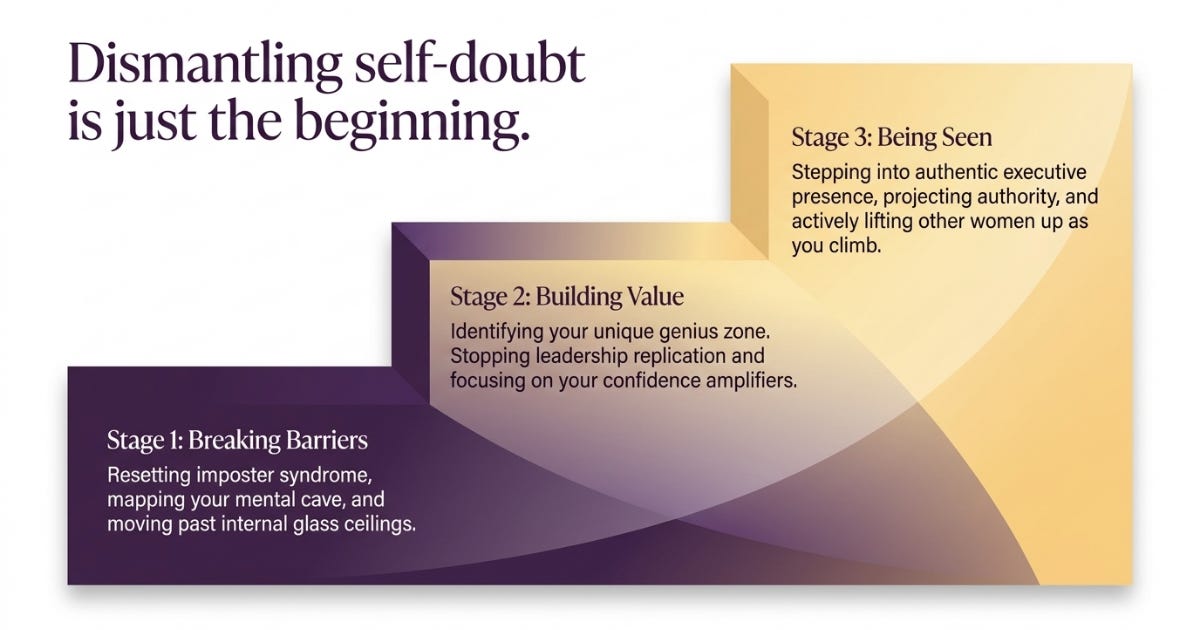
Dismantling negative self-talk is one component of a broader leadership transformation. To build sustainable authority, you must navigate through all three stages of internal development:
Breaking Barriers: Moving past internal glass ceilings, dismantling negative self-talk, resetting imposter syndrome, and understanding how fear impacts your performance.
Building Value: Identifying your unique genius zone. Your combination of skills, background, and perspectives is entirely unique. When you understand your core value, you stop trying to replicate someone else’s leadership style and focus on building your confidence amplifiers.
Being Seen: Stepping into authentic executive presence. Once you know who you are and what you bring to the table, you can project authority, expand your organisational influence, and actively lift other women up as you climb.
Step Into Your Authority
You do not need to wait until your inner critic disappears before you apply for that promotion, negotiate your compensation, or lead that strategic initiative. Self-doubt is simply a sign that you are expanding your boundaries.
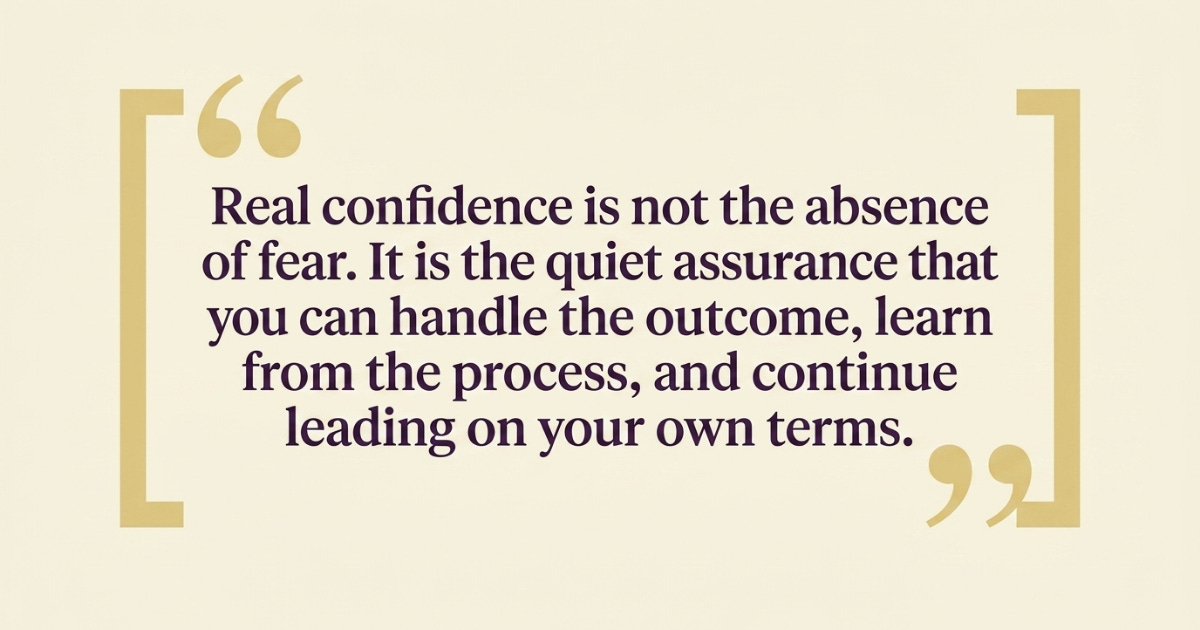
By mapping your mental cave, keeping a positive evidence diary, and challenging outdated scripts, you reclaim control over your professional journey. Real confidence is not the absence of fear. It is the quiet assurance that you can handle the outcome, learn from the process, and continue leading on your own terms.
Accelerate Your Leadership Journey
If you are ready to break through your personal confidence blocks, silence your inner critic, and co-craft a tailored reset script for your professional environment, explore our dedicated coaching resources.
Book an Imposter Syndrome Reset Session: Work one-on-one with Leadership Coach Jennifer Cowley to map your specific internal barriers and build an actionable career strategy. Visit jennifercowley.com/reset to book your session.